
Everyday Carry (EDC)
Everyday Carry (EDC)
In this blog post I want to talk about Everyday Carry, and more specifically, things to consider when setting up your EDC or concealed carry gun.
First off, I’m going to state this clearly: your carry gun is going to end up being the gun you should maintain the most.
Your carry gun is going to experience temperature changes from hot to cold. It will go from dry to sweaty. It will collect lint, dust, and other debris (seriously… how did that Skittle get in there?) far more than most of your other guns. As the gun you carry every day as a means of self-defense, this is the firearm you need to ensure works when you need it most.
With all of that being said, you should set up a system that forces you to check and clean your carry gun as needed. A good standard is to inspect, clean, and lube it once a month, or more often if you’ve been in inclement weather. If you run a red dot, replace the battery once a year. If you run a pistol-mounted flashlight, replace those batteries once a year as well.
What Makes a Good Carry Gun?
So let’s move on to the carry gun discussion. What actually makes a good carry gun?
There are several things to consider:
- Size of the gun (including weight)
- Caliber
- How many rounds it holds
- Sighting system
- How you intend to carry it
- How it shoots
Does it shoot in a way that’s pleasant and controllable, or does it beat you up at the range?
How Do You Plan to Carry?
Let’s jump into how you plan to carry your EDC gun. There are a lot of different ways to carry, and your job, daily activities, and dress code may dictate things more than the gun itself.
For example, an office worker may dress very differently than a tow truck driver in the winter. The office worker might be in business casual, while the tow truck driver in our area is likely wearing heavy outerwear, coveralls, or bibs.
The office worker may be able to get away with appendix carrying a smaller pistol or using a concealed carry holster that works well under lighter garments. The tow truck driver, on the other hand, needs a way to keep their EDC accessible when needed and may look toward a shoulder holster under a coat or even a chest holster like backcountry guides use.
In this example, the tow truck driver is less concerned about the size of their carry gun, while the office worker may struggle to conceal larger pistols.
If you’re in the market for your first EDC pistol—or a new one—you need to think about:
- How you plan to carry
- On-body vs off-body options (belt holster, appendix, bag, purse)
- What activities you won’t carry during (gym, certain work environments, etc.)
As we move into 2026, the options for carry guns are almost unlimited. You can now get very small guns that carry a lot of rounds and are reliable enough to trust your life to. On top of that, the concealed carry holster market is massive, with options for just about every situation.
Size and Weight Matter
Now let’s talk about the physical weight of the pistol and the additional ammo you’re carrying.
A .380 Glock 42 with three reloads (24 rounds) is always going to be lighter and smaller than a 9mm Glock 43X with three reloads (30 rounds). That Glock 43X is going to be lighter and smaller than a Glock 19 with two reloads (45 rounds).
All of these are great pistols, but size and weight are real factors you need to think about. If you plan on carrying in a purse or bag, add a couple of pounds to it and see if you notice it after a full day.
Caliber
We are at the heyday of concealed carry, and have been for the last 15–20 years. The massive increase in people carrying has pushed ammo manufacturers to design better and better defensive rounds.
Because of this, we’re now seeing police departments switch back from .40 S&W to 9mm. Why would they do that? Think about it this way:
- If both calibers have similar stopping power, but 9mm has less recoil, 9mm wins
- If both have similar stopping power, but you can fit more 9mm rounds in the same size gun, 9mm wins
- If both have similar stopping power, but 9mm is cheaper to buy and train with, 9mm wins again
This brings us back to the question: What caliber should I carry?
I personally recommend 9mm the majority of the time for most people. One of the biggest reasons is cost. 9mm practice ammo is usually one of the least expensive options available, which means you can practice more.
More practice means better performance if you ever need to use your gun.
Now, if your idea of practice is shooting 50 rounds a year—or never practicing at all—then caliber really doesn’t matter, and you can probably stop reading here (we’re not the shop for you).
On the other end of the spectrum, if your EDC is meant to protect you from dangerous animals like bears, I wouldn’t recommend 9mm. In that case, you should be looking at calibers like 10mm or .44 Magnum, but that’s a whole different conversation.
Sights
“You can’t expect your bullets to hit the target if you don’t aim.”
Pistol-mounted red dot sights are extremely popular right now, and the concealed carry market has pushed manufacturers to make smaller and better options. As carry guns got smaller, the optics designed for them did as well.
Red dots are great, but they have weaknesses—batteries and electronics—so they need to be maintained and checked. You also need to train with them. If you run an open-emitter optic, you need to keep it clean and free of debris.
If you don’t run a red dot, then you’re relying on iron sights. There are plenty of options there as well, including night sights and fiber optics.
If you ask me what I recommend, it’s this: if you’re running a red dot, use a closed-emitter optic and mount it as low as possible so you can still use your iron sights through the optic if the dot goes down.
How Does It Shoot?
Story time.
A number of years ago, a friend asked me to go to the range with him, his wife, his brother, and his brother’s wife. At the time, XD pistols were extremely popular, and both my friend and his brother had XD subcompacts in .40 S&W.
Right away, it was obvious recoil was an issue for some of the group. I had brought several 9mm Glocks, including a 19C, and a Glock 42 in .380.
As we worked through the guns, everyone agreed that the 9mm pistols were far more enjoyable to shoot, and the smaller Glock 42 was especially comfortable for shooters with smaller hands. Prior to that, accuracy had been an issue, and after a few magazines of the .40 subcompacts, flinching started to show up.
That leads me to ask people this: how does your carry gun actually shoot?
If you don’t like shooting it because of recoil, or you can’t shoot it accurately because of ergonomics, trigger, or sights, you may want to look at a different carry gun.
If you love the gun but want it to shoot flatter or faster, there are options. Slides and barrels can be ported, compensators can be added, and drop-in compensated barrels are available for many popular pistols.
What I Recommend
When people ask me what I recommend for a carry gun, I tell them there are a lot of good options available right now. A small-frame 9mm from any major manufacturer is a solid starting point.
I tell people to:
- See what fits their hand
- Pay attention to the trigger and sights
- Try to shoot it before buying if possible
When people ask what I carry, I’m honest. I switch between a Gen 3 Glock 19C and a Glock 43. Both are 9mm and both run iron sights.
I usually get the response, “Oh, you’re a Glock guy.” I am. I’ve been running Glock handguns since 1995, and I trust my life to them. That said, when I started carrying, we didn’t have the options we have today.
If I were starting now, I would also tell people to look at:
- Sig P365 series
- Springfield Hellcat
- Smith & Wesson M&P pistols
I’ve shot all of them and would carry any of them without hesitation.
If Money Was No Object
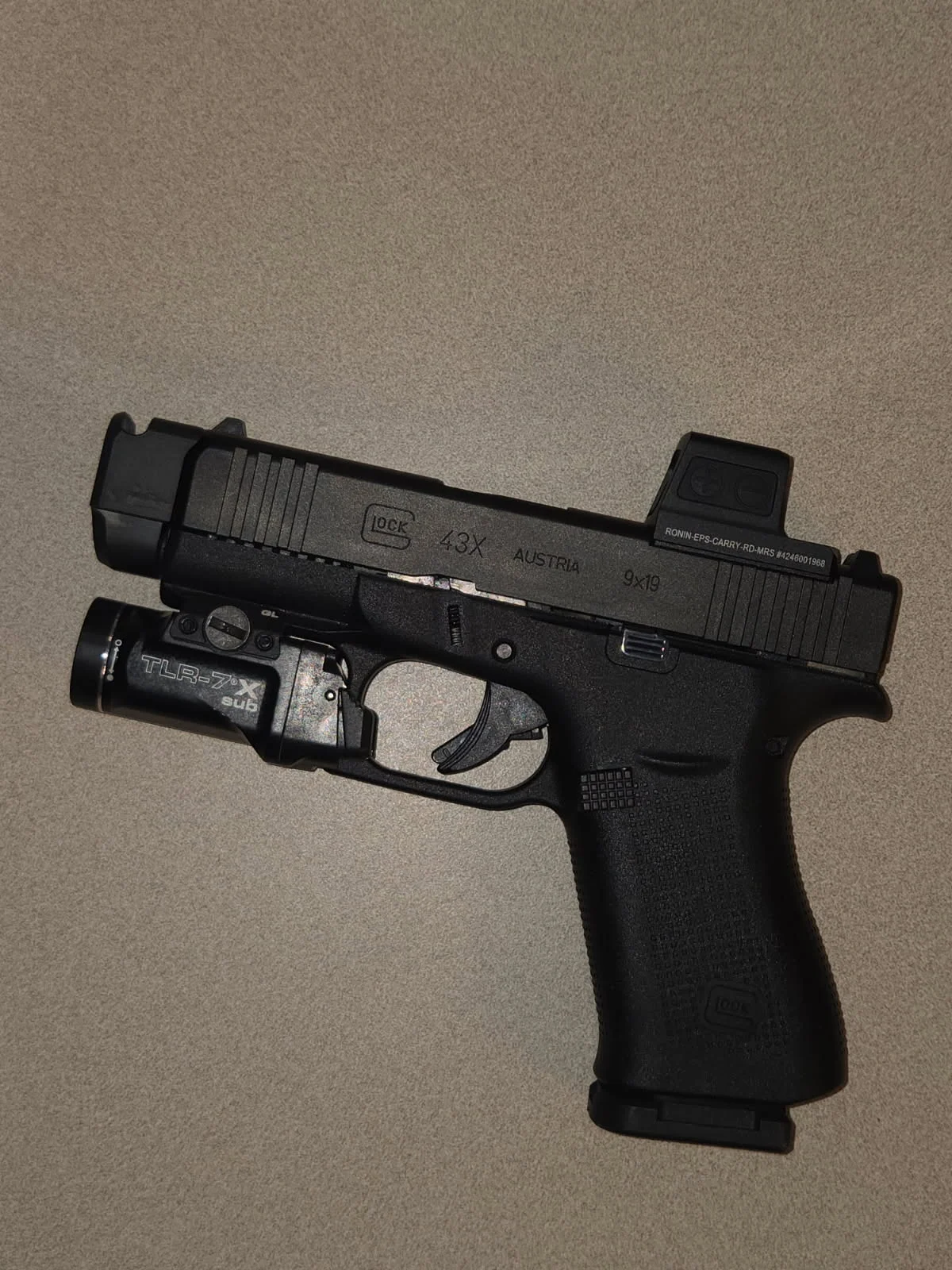
If someone told me to set them up with the ultimate carry gun and money wasn’t an issue, and they wanted a Glock, I’d start with a Glock 43X MOS. I’d either have it ported or add a Parker Mountain Machine compensated barrel.
For sights, I’d run a closed-emitter mini red dot from Vortex or Holosun. I’d add a small-frame pistol-mounted light from Streamlight and finish it off with Shield Arms 15-round magazines.
If they didn’t want a Glock, I’d go with a Sig P365 X-Macro Comp. If not that, then a Hellcat Pro Comp OSP with an optic and light added.
If Money Is a Consideration
For most of us, money matters.
In that case, I recommend starting with a quality pistol like the Glock 43X MOS and learning to shoot and carry it as it comes from the factory. Upgrade magazines first to increase capacity. Add a red dot when funds allow. Save porting or a compensator for last.
Gun Owner or Gunfighter?
Collector or Protector?
The choice is yours. Stronghold Corp Helps YOU Earn It!
-John
Related Post

Worth the Drive?
Worth the Drive? Worth Your Time? Definitely. Farmersburg, Iowa. If you had asked me where that was 15 years ago,…
Everyday Carry (EDC)
Everyday Carry (EDC) In this blog post I want to talk about Everyday Carry, and more specifically, things to consider…
The Adult Aversion
In this blog post, I want to talk about something that is very near and dear to my heart: firearms…